Successful change management is crucial for organizational survival. Darvin’s words: „It is not the strongest of the species that survives, nor the most intelligent ones. It is the one that is most adaptable to change“ show us the importance of resilience. It’s the same for organizations – those who cannot adapt lose their competitiveness.
Many projects and initiatives fail despite the resources invested. How is that possible? The secret of successful change management lies in the human factor. The individual people are the ones who need to accept the change, behaviors, or processes in question, therefore it is very important to focus on their awareness, desire, knowledge, ability and reinforcement potential, which, unfortunately, not many companies do.
The ADKAR® model, created by the founder of Prosci®, Jeff Hiatt, that focuses on individual changes, provides five key elements for successfully implementing changes:
- Awareness: Creating awareness of the need for change and the risks if it does not occur. By answering questions such as “Why is this change necessary?” and “How will this change affect us?” we are helping people understand why the change needs to happen.
- Desire: Creating a desire for change and understanding how the change will benefit individuals, overcoming previous unsuccessful initiatives, considering personal circumstances, and motivation for accepting change (answering the question “What’s in it for me?”).
- Knowledge: Providing the necessary knowledge to implement the change. Education, training, and understanding of new roles and processes help people adapt successfully.
- Ability: Providing resources and support so that individuals can adopt changes. Psychological, physical, intellectual, time, and resource factors that can affect the ability to adopt change are taken into account here.
- Reinforcement: Maintaining change after implementation. Tactics such as celebrating success, rewarding, gathering employee feedback, reviewing and analyzing success, as well as the leader’s sense of responsibility for change…
This model indicates that changes do not end after implementation but that regular maintenance, monitoring of success, and adjustment are necessary. Communication, motivation, and continuous support are key to maintaining change within an organization. By carefully considering each step of the ADKAR® model, organizations can better understand what is needed for changes to be successfully accepted and maintained. This can lead to increased competitive advantage, greater adaptability, and better results in everyday business.
Let’s look at how the ADKAR® model can also serve for individual employee analysis and action planning:
- Create an ADKAR® profile for each employee in the team.
- Identify individually where the rating is 3 or lower – that’s the current obstacle to accepting change.
- Develop a plan on how you will help the employee overcome the obstacle.
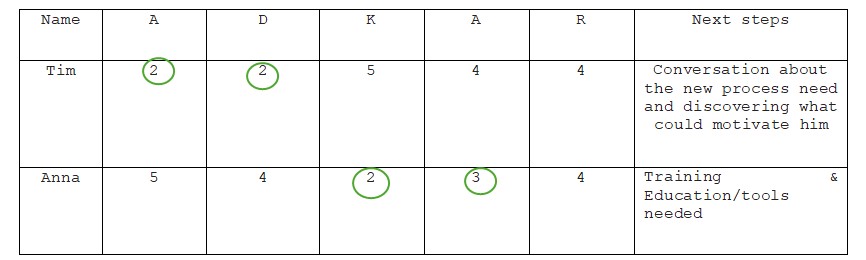
In the given example, we see two employees – Tim and Anna. Tim possesses knowledge and skills/abilities, but he is unmotivated and does not understand why this change is necessary now – he resists it. The next potential steps involve conversations with Tim, creating awareness of what will happen to the business/people if the change does not occur, explaining how he benefits from this change (“what’s in it for me”), and finding ways to motivate him.
I’ll give you an example from my experience. Some time ago, I was responsible for leading a team of 36 trainers from 4 different countries (also 4 different time zones). These trainers held permanent positions in the company but were chosen as exceptional talents and experts in their field to spend part of their working time educating their colleagues globally. After noticing that it was extremely difficult to track their contribution, progress, and work remotely, I proposed introducing a new process – recording hours spent and topics covered every month.
It looked like this: the exact number of hours they would spend on education was agreed upon with their superiors, then a platform was created to record their work, and a process for rewarding the best quarterly trainer was devised. But the most difficult part was missing – motivating trainers to accept “one more task” and to keep regular records. Instead of just announcing the introduction of a new process, we made an effort to anticipate all their “whys” in advance, explained to them that one of the department’s goals was to increase the number of volunteer trainers and that when their number doubled in a few months, it would be very difficult to track their performance. Also, if we don’t have recorded hours and data on their work, their absence from their primary job can be questioned, and their work may not be adequately rewarded. In this way, we showed that the new process aligns with the company’s goals and created awareness among the trainers that this change is necessary and beneficial.
Let’s go back to our example employees. The second example is Anna – she understands why this change is needed and she is very motivated, but she lacks the knowledge and skills/abilities to successfully implement the change. In that case, potential next steps for Anna are training and education, as well as appropriate tools for work.
In our previously mentioned example, trainers went through training on how to use the work recording system, then both trainers and their supervisors were thoroughly explained how the percentage of working hours would be calculated and what the agreement process would be if it was necessary to change the number of hours the trainer devoted to education. The rules for rewarding the best trainers were also thoroughly explained.
The ADKAR® model is a great way to help leaders and your project team successfully implement change. Even the most expensive, most modern processes, if not implemented properly, fail. And don’t forget – follow every step to guarantee success, and if you accept ADKAR® as a change management model, you can use it in many situations, not just in business. It will give you a completely new perspective on the world and help you understand other people more deeply and efficiently.